




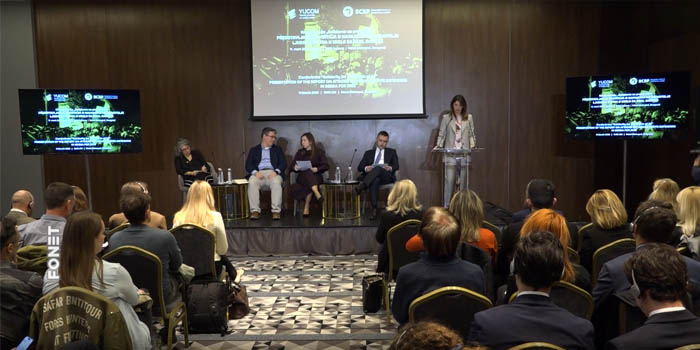
In 2025, 317 attacks on human rights defenders were recorded in Serbia, the Lawyers’ Committee for Human Rights YUCOM and the Belgrade Centre for Security Policy (BCSP), which conducted the research, said.
According to the report, the police carried out the largest number of attacks on activists, around 32 per cent, while the media were responsible for attacks in 21 per cent of cases.
A total of 51 per cent of the attacks were physical, while electronic attacks accounted for 31 per cent of cases.
According to the report, most attacks in the previous year occurred in cities outside Belgrade, accounting for 67 per cent, while 33 per cent took place in Belgrade. Compared with 2024, the number of attacks on activists increased by 151 per cent; in that year the report recorded 126 attacks.
As stated at the conference, the research does not include attacks on journalists, as a separate study exists for that “because there were many attacks”.
The Director of Research at YUCOM, Milan Filipović, said at a press conference that the report found that a large number of people who presented themselves as police officers were in fact not police officers but supporters of the authorities.
“The police did not react to the attacks, and everything culminated in the use of a sound cannon on 15 March. Our state authorities did not properly investigate the case. There is a lack of accountability for all the attacks, and the President of Serbia himself justified people who hit citizens with cars during the protests,” Filipović stated.
He added that new spyware had been developed and that more than 600 activists had found such software on their phones; according to him, there may be more than 1,000 people whose devices were illegally fitted with such software.
BCSP Director Ivan Bandović stated that people who had been wiretapped were “victims of the authorities, as well as their families”.
“When you do not have institutions that fight corruption, then you are left only with journalists and activists doing so. Better oversight of the authorities is needed, and domestic institutions should resolve this issue. Except when it comes to 15 March last year and the sound cannon, that is a matter for the Council of Europe because a weapon was used,” Bandović said.
The United Nations Resident Coordinator in Serbia, Matilda Mort, said that human rights defenders ask uncomfortable questions, but that this is necessary for a democratic society.
She added that activists, journalists and students have taken on the responsibility of defending human rights, and therefore deserve recognition, as well as for calling on institutions to do their job.
The United Nations Special Rapporteur on the situation of human rights defenders, Mary Lawlor, said she had hoped that after her official visit to Serbia, she would report progress, but claimed that all her attempts had failed due to attacks on students and activists. “Human rights defenders remind us of the number of attacks; they demand justice and security. Serbia has committed itself to protecting human rights but has chosen to ignore them. Many young people remained silent and did not report attacks because they feared retaliation if they did so. I am afraid that the figures in the report represent only the baseline; there were many more attacks,” Lawlor said. She added that more than 80 per cent of the attacks were linked to peaceful mass protests.
Lawlor also stated that one of the features of the report was that many ordinary citizens who had not considered themselves activists became activists due to the “retaliation they faced from the authorities of their own state”, assessing that this must not happen in a democratic country.
“If a government allows campaigns of digital attacks against activists, this often encourages physical attacks. Particularly worrying is the labelling of activists as Nazis and terrorists. The international community must remind the authorities that they must listen to activists, stop the attacks and carry out investigations. The biggest problem is that institutions that should be protecting people are actually serving other interests,” Lawlor said.
Participants at the conference agreed that Serbia is one of the few countries that focus less on civil society.
(N1, 11.03.2026)